Saturday, March 22, 2014

Clinic 2: Over the Meadow & Through the Woods to Pajuhun We Go

An important message…I have been having technology challenges in posting and uploading to the blog.  There is no time to write during the day and the only Internet connection is in the canteen where we eat.  By the time dinner is over, there is only an hour before the canteen closes and many people are online at that time so nothing happens quickly.   Please be patient and keep reading even after we return home.  I hope you are interested and continue reading because the children and people of Sierra Leone need you.  I pray you will be moved to help.
*******************************************************************************
Today was a very special day and I cannot find the words or time to capture the true essence of it. I don’t want to ever forget this day—“the day that the Lord made.   I will rejoice and be glad…” I was there.


The morning started with Carol, Debi, and Ju leaving at 6:30 A.M to travel to Bo to pick up more needed medication.  Wow!! They ended up with a story to tell.  They made it to the pharmacy in Bo but the car they were traveling in broke down and they had to wait for another way to meet us. They did take advantage of the opportunity to visit a school and play with the children.  I am amazed at how easy it is to entertain the children and get a smile from them.  They enjoy the simplest games and are easily persuaded to join in. While a few of them are reluctant to interact with us initially, it doesn’t take long for them to warm up.  Of course, when you have Carol around, it’s hard NOT to have fun. She ran and jump roped with them and showed them their own reflections in the mirror.


Margaret & Laura
For Debbie, Tonya, and Laura, the day began by seeing a patient for follow up from the day before.  A grandmother walked several miles pushing her granddaughter’s (Margaret) wheelchair to come to our location to enable the team to administer treatment in privacy.  She was here at 7:30 A.M.  Margaret has spina bifida and suffers from a fistula.  She was so brave as the team worked to insert a catheter to help alleviate some of her problems.  Despite pain, she was quiet and remained very still.  Only one tear escaped and ran down her cheek.  I remember how sad my team members were 30 minutes later when they had to tell the grandmother (through a translator) that the procedure was unsuccessful.  However, they were able to make arrangements for her to be seen at one of the two fistula clinics in the country.  She will be able to get help. 

Next came breakfast and then Tonya led the devotion which centered around serving others. The scripture was in 2 Cor. 9.  After prayer, we loaded the buses with our supplies and began the bus ride from Njala to the place “where the road ended and the walk began. “ I planned on posting a video showing the entire path we took into the village but sometimes (or “often” may be more fitting) I am technology challenged and while I filmed the entire walk, I failed to switch my camera setting to video.  I was able to get a little video so you can at least get an idea. Perhaps, it was divine intervention--the entire "clip" would have been equal in length to a full- length film.

We had asked how far we would be walking and were told it was about 150 meters—not far at all.  What an adventure on a narrow footpath through woods (up and down), grasslands above my head, beside a bridge that is necessary during their rainy season, and through a small village with a few huts.  All our supplies—suitcases, boxes, and water were carried on the heads of the villagers (mostly by children) and by our Sierra Leone staff.  The journey turned out to be a little over two miles.
We arrived at the palm frond-covered dwelling that would be transformed into a clinic quickly.  Parents (mostly moms) with their babies and children were already there waiting patiently.  While we were setting up the clinic and pharmacy, we began to hear the voices of children singing.  A few minutes later, a procession of school children became visible.  They sang songs of welcome to us and also some Christian songs.  Their sweet little voices and smiling faces will remain with me for a long time.   Out team sang “Jesus Loves the Little Children” to them when they concluded.  While singing, I decided that I really wanted to look into each face before we opened the clinic.  Working in the pharmacy is busy and doesn’t lend much extra time.  I went down the line of children touching each one and looking into each face.  Then I was ready to begin knowing that what we were doing mattered.  After prayer asking for God to protect our team and use us to help and heal the children, the clinic opened.  


We began without Dr. Debi, Carol, and Ju since they were still trying to make it to us.  We were really thankful a couple of hours later when they arrived.  The school children remained near the pharmacy throughout the day and occasionally there was a moment when I could make silly sounds, faces, and gestures and they would imitate me every time.

We ended up seeing about 150 children and a few adults.  We had a little time after the clinic ended to gather all the children in a circle and do the “Hokey Pokey” with three team members.  Their teacher translated for us.  Pastor Francis also played a game with them and then we distributed toothbrushes and toothbrushes.  A presentation of soccer balls with pumps followed and then the day ended with the chief thanking us and presenting the team with gifts.  We were given with six pineapples which represent hospitality, a huge plastic bucket of rice symbolizing their desire to share what they can, several bunches of plantain—the food of children because we were helping their children, yams larger than I have ever seen, and a live rooster, the highest honor someone can give to another.  Once a year, they pick out the largest chicken they have and give it to honor someone else.   As I write this, tears rundown my face.  The villagers are poorer than anyone I have ever seen yet they generously gave to us.  Pastor Francis, serves Pujahun as well as eight other villages in the district.  He visits each village every fourth day.  He makes less in a month than a minimum wage employee in the U.S. would make in a day.  Having a chance to treat and help them pales in comparison to the generosity of these people.

Everything was gathered up on the heads of the villagers and our helpers and hand in hand with four children, it was time to close out our day.  After the 2+ mile walk back to the bus, we said our goodbyes and headed back to Njala.  After a shower, we went to dinner at 7:30 and then went back to restock for the next day’s clinics.  Tomorrow, we go to Gola, a village even poorer than Pujahun.  We also plan to visit an orphanage in Bo. 


Clinic 4 in Taiama and Baby Kenneth

The day began as usual with breakfast and a devotion. Carol gave each of us four hearts with four different Bible verses printed on them.  One verse stood out to all of us.  The verse emphasized loving and serving through our actions and deeds. Saying we love and want to serve mean very little.  I am discovering what it truly means to serve without expecting anything in return—just serving.   Since arriving in Sierra Leone I have seen poverty like I’ve never seen before—people who lack everything that I take for granted—clean water, electricity, a spacious home with doors, windows, and protection from mosquitos, excellent medical care, reliable transportation, easy access to almost any place I want to go, plenty of clothes, etc.  Yet, these people seem happier or accepting of life as it is.  And to think how I often complain and express irritation when life doesn’t go MY way.  This experience has reminded me of what really matters most in life—loving as Jesus demonstrated for us.  I am working harder than I have in my life yet I struggle because we see so much need.  It is always hard to end a clinic but so far, we have not turned anyone away who has been waiting in line.  I am thankful for the commitment of our team and their willingness to graciously and lovingly work in the hot and sweaty temperatures, the dirty conditions, and cramped space to give so many children the chance to live a healthier life with minimal pain and long-term suffering.

Before leaving for today's clinic in Taiama, Ju wanted to meet with the entire team.  We all gathered in a room in the guesthouse.  He presented each of us with a gift from him and his sister, Evelyn.  Evelyn had made each of the women a dress or top.  We were also given a bracelet and sandals.  Each garment was unique and I know alot of time went into making these garments for us.  I am not accustomed to such generosity and sacrifice of time.  Evelyn is not working with us this year because she is grieving the death of her fiancee'.  Knowing that she made this clothing during this difficult time for her leaves me speechless.  I look forward to wearing my dress and sandals once I get home and the weather improves.  

The Taiama clinic was held in a building with two rooms with a connecting door.  The pharmacy had a window that allowed us to pass prescriptions out to the interpreters so they could provide parents with instructions for each child’s medicines.  Suliman did an amazing job as interpreter and Ju was also a big help to him.   These two young men are incredible!!   They are smart, mature, organized, warm, patient, and forgiving.  Lucy Kangaju also served as an interpreter, working with the doctors.  These three adults are Christians who love people so much and want to help them in any way possible.  Without them, we could not have done this work.


Via a covered breezeway, this clinic is connected to a maternity ward with a small delivery room.  (This space will become very important later in the day.) A couple of other rooms offer a few beds for sick adults.  The nurses have limited training and limited equipment, medicines, and medical supplies.  The facility would be deemed deplorable in the United States.  They are definitely not sterile environments.

Relevant Fact: 1 in 5 infants die at or during birth in Sierra Leone. A woman qualifies to be a TBA (traditional birthing assistant) if she has given birth or seen a birth one time. They don't have equipment we deem necessary for deliveries. For example, they lack scissors to cut the umbilical cord as well as suctions bulbs and resuscitation bags. Often just clearing mucous from the newborn's airway and giving them a few assisted breaths will make the difference in life or death.  
little boy with serious fungal infection

a closer look at the infection 
The clinic at Taiama began and proceeded differently than the previous three because the nurses insisted that we see adults as well as children.  They argued that Pastor Francis had told them that we would be treating all.  The nurses didn’t accept the fact that we lacked medications that we would most likely need to treat adults.  Ultimately, the doctors decided that Tonya would see adults and Debi would see the children.  We said a prayer together and clinic opened.  We were busy for hours and treated many people for worms, malaria, respiratory ailments, fever, chronic pain, asthma, fungal infections, staph infections, and wounds that had not been adequately cleaned, medicated, and bandaged. 

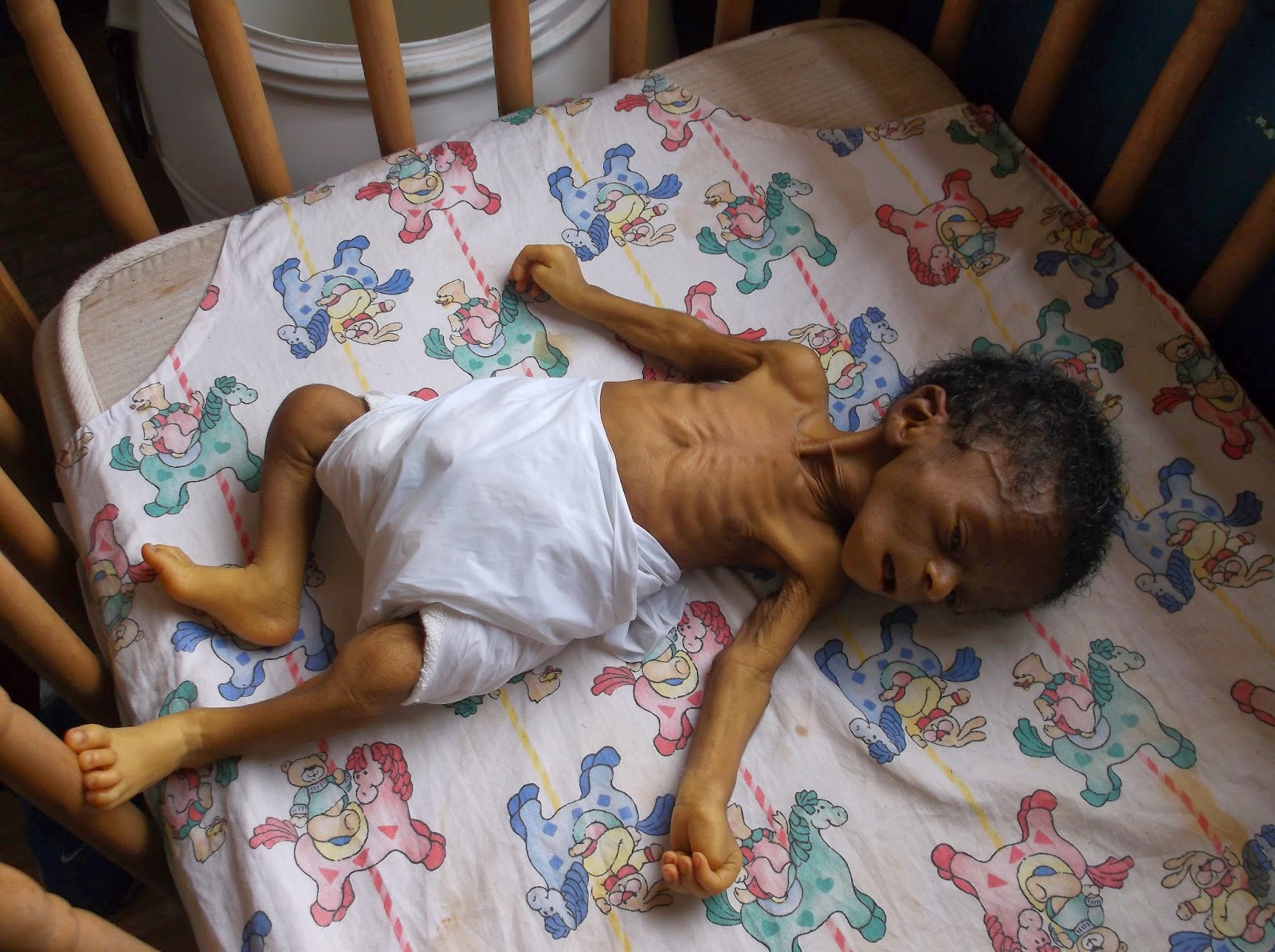
About 2 P.M., Tonya and Debbie stopped clinic to take care of a critical patient.--a three-week-old baby needed immediate attention.  The first-time mother had walked from another village with her infant concerned because he kept losing weight.  He appeared extremely thin and his breathing was slow.  The examination revealed that he had a fever of 103.6.  The doctors hurried the baby to the maternity ward and Laura quickly gathered supplies to administer an IV.  At Laura’s urging, I went to see the baby.  I was not prepared for what I saw.  I couldn’t stay long. I felt so sad and helpless.  The most I could do was take the young mother some water.  I could only imagine her fear as she entrusted her tiny, sick baby to strangers.  I’m not sure how aware she was that her baby had minimal time left on this earth without immediate care.  These people are much accustomed to seeing death—the death rate of their children is near 50%.  Dr. Debi “went to work” on this infant, assisted by Tonya and Laura.  The infant needed an antibiotic but Debi was concerned about hitting a vein on the first attempt. She asked everyone to pray and it happened on the first try. 

The treatment team provided professional, tender, attentive care to this infant for over an hour and then came the “waiting game.”  Only time would tell if the baby would live through the day.  If it lives, there may be residual damage.  To do well, the infant will need follow-up care.  However, with no money or transportation, future care available for the infant will be at the Taiama clinic staffed by nurses, both LPN’s and a few RN’s.      

After handling the emergency, clinic reopened and the people still waiting were seen.  After Dr. Debi saw all the children waiting, she offered training for midwives/TBA's and gave them supplies that will be so helpful when new babies are brought into the world.  She distributed scissors and suction bulbs that we brought from the states and ambu bags (donated by Henry County Medical Center). We finished around 4:30 or 5 after seeing and treating 178 men, women, and children.  The doctors checked on the baby and were pleased to see positive changes had already occurred.  The team has saved this infant’s life. We'll return in the morning to check on the baby and administer more medication.

We packed up most everything, donated some needed medicines to the clinic, and took a few pictures with the nurses, midwives, and children before leaving.  Each time we “snap” (photograph) the children, they love seeing the pictures.  These children smile often but I find it funny that whenever you “snap” a camera, the smiles disappear for a moment especially in older children.  However, they laugh when they see the pictures afterwards.  Just think…most of these children have never seen a reflection of themselves unless they have been near water.  While they recognize other children in a picture, I’m not convinced that they recognize their own image.  Carol usually had a mirror with her at the clinics and gave several children the chance to see their own reflection.


We returned to Njala after a long but rewarding day.  We were hot, dirty, sweaty and most of the team was ready for a shower.  I desperately needed some alone time so I took a walk around the campus, inside the gated area since I was unaccompanied.  I took pictures of my surrounding some of it so beautiful and unique.  The new construction contrasts sharply with the ruins that provide evidence the destruction caused by the rebels 10+ years ago.  I returned to my room and sat down to write and listen to music—the favorites of our team.

A little after 7:30, I joined the rest of the team for dinner.  This was our last night on the Njala campus.  We all laughed together and joked about our idiosyncracies.  We returned to our rooms to pack for the next day and I went to my room to download pictures from my camera and cell phone as well as Robert and Debi's cell phone.  It's now almost midnight and I must get some sleep.  Tomorrow will be a long, full day and I want to be ready for it.

Good night,
Jane

Monday, March 17, 2014

First Day of Clinic

I begin by acknowledging my limitations in sharing what has happened since we arrived in Sierra Leone.  Sure, I can tell you what we are doing each day but that isn’t enough.  I wish you were here so you could see for yourself because I WANT you to know.  Despite feeling inadequate, I forge ahead in an effort to connect you, not only with us, but also with your neighbors in this country.  I pray that God will provide the words.

Sunday was really busy, but also wonderful, tiring, overwhelming at times, and rewarding.  During breakfast (8 A.M.), we received a message that people were already filling the place where our first clinic would be held in the afternoon.  I couldn’t comprehend so many mothers with infants in arms and children in tow willingly waiting so long for our arrival. Then I remembered that many people in these villages have no access to a medical doctor and medications to help their sick little ones.  They love their children and face the reality that many will not reach adulthood.  I am thankful I can be here with such a committed, compassionate, hard-working team of people to offer what help we can.
 
 After breakfast, we went to church in Taiama.  I loved the fact that the people were so open with their praise and worship.  They sang in jubilation, and at other times, prayerfully.  I loved the drums that accompanied the music.  The scripture was read in English but the music and prayers alternated between English and Mende.  I was deeply touched when the pastor said a prayer for the Americans who were here to help the sick.  He asked God to protect us as well as give us strength to do our work.
I left the church ready to get started with our first clinic.
After a quick stop back at the University for a devotion and nourishment (both physical and spiritual), we loaded up four suitcases of supplies and medicines, adding them to the 10+ boxes that Robert and Ju had gotten earlier from the pharmacy. When we arrived in Njala, I knew the clinic’s location instantly.  I saw the throng of people and the faces of many children waiting with their mothers.  At that moment, the needs I had thought I understood became reality.  I felt humbled, overwhelmed, inadequate, and unworthy.  In this case, even a picture cannot capture the sight I beheld.  As I write now, tears rush down my face and I am overcome with emotion (just as I was then).  I thought it would be impossible to treat all these children in the five hours we had.  How could they be examined by the doctors, prescribed medications, and those prescriptions prepared and explained to mothers who didn’t speak English?  I could not fathom having to send any child away without being treated.

Picture our clinic – two tables (maybe 4x6 feet) and a few chairs.  We used one table for Dr. Selby and Tonya Nash to see patients and the other was used for the pharmacy. Think about all the supplies we had brought.  The space we had was all we had so we made it work. Just like the people of Sierra Leone, we had to be resourceful and I am finding that I can be. Within a short time, the clinic began.  I’ve worked with numerous groups of people in my lifetime but I can tell you, I’ve NEVER worked with such a dedicated group.  I can’t remember working any harder than I did today (and those who know me best know I am hard worker) and I was not alone.

We treated a total of 204 infants and children in five hours.  Very few of the children were deemed “ well babies” but when we saw a prescription sheet with those words, we rejoiced.  Children were treated for common things such as runny noses, intestinal viruses, and fungal skin infections that are much worse due to the hot climate.  Many were also treated for things rarely seen in America such as malaria, intestinal worms, and severe outer ear infections (similar to our swimmers' ear).  The sickest baby was the last patient of the day who had pneumonia.     
The highlight of the day were three sets of twin babies.  God answered my prayer, at the end of the day, we did not have to turn away a single child--every child who came to today’s clinic was seen.

Clinic ended, we packed up everything, played with some of the children who lingered in the community center, and boarded us bus to return to Njala.  As we drove away, we threw candy from the windows and the children ran after the bus to get a single piece of candy.  Supplies were returned to a room to be inventoried after showers and dinner.   The team gathered for debriefing and ideas for improving the next clinic were offered.   Afterwards, the “docs” made a list of medications to purchase for tomorrow’s clinic and 4 suitcases and 8 boxes were organized in preparation for our trip “across the river” tomorrow to Pujahun. 


I close by letting you know that some things that happen in Sierra Leone are “bloggable” (our team coined this term) and some are not.  Here’s something bloggable for today.  I haven’t mentioned the heat – I try to pretend it isn’t real.  However, the fact that Tonya and I sweated like crazy today attests to the heat but also the fact that one team member discovered that her toenail polish had melted onto her socks gives you an idea of the temperature.  Sweat baby sweat! It’s a small price to pay to have a chance to show God’s love and compassion and do what we have been called to do.